
Millions of users save short-form media daily, yet few understand the complex systems powering these tools. SnapTik stands out as a leading platform for fetching high-definition media without embedded logos or username tags. Have you ever wondered how SnapTik works behind the scenes when you paste a link into the search box?
Behind its minimal landing page lies a sophisticated distributed network. This infrastructure parses dynamic scripts, bypasses anti-scraping filters, locates clean media streams, and delivers raw video files within seconds. In this technical breakdown, we will explore the architecture, APIs, and data extraction pipelines to uncover how SnapTik works behind the scenes.
How SnapTik Works Behind the Scenes: The High-Level System Architecture
To process millions of requests every day, SnapTik relies on a lightweight microservices architecture. The platform splits workloads across specialized edge nodes, serverless backend instances, and content distribution networks (CDNs). Understanding this infrastructure is essential to seeing how SnapTik works behind the scenes to maintain low latency and high availability even during viral traffic spikes.
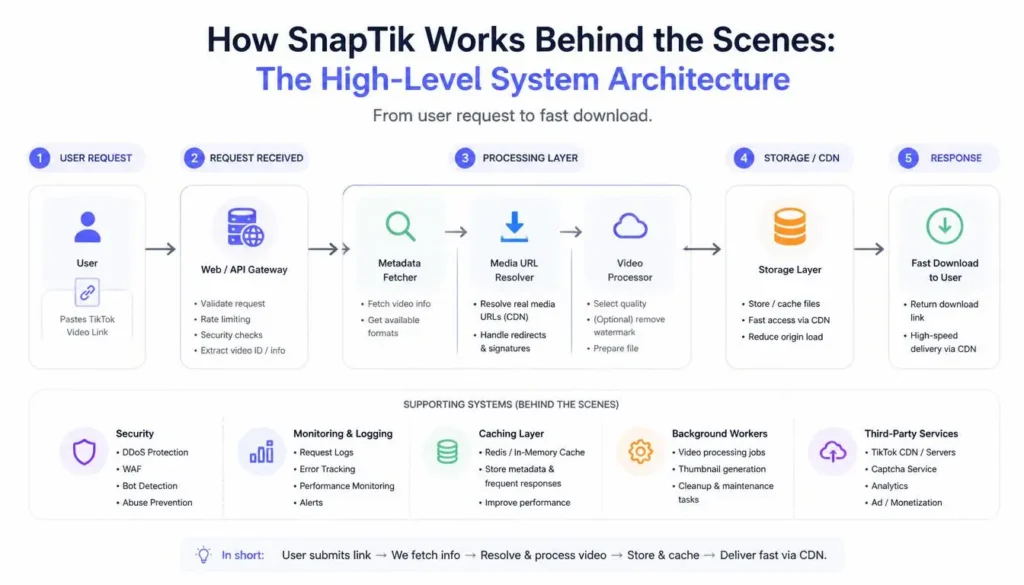
The system does not store heavy video archives on its own servers. Instead, it functions as an intelligent real-time extraction middleware. Therefore, the backend acts as a relay between the target social media platform and the end user.
Key Components of the System Architecture
- Frontend User Interface: A minimal, lightweight JavaScript client that handles input validation and asynchronous API polling.
- API Gateway: Manages incoming web requests, rate limiting, and request sanitization.
- URL Resolution Worker: Expands shortened mobile share links into full canonical web links.
- Scraping and Proxy Layer: Rotates proxy IP addresses and HTTP headers to mimic genuine mobile devices.
- Metadata Parser: Extracts hidden video manifest files, JSON payloads, and media pointers.
- CDN / Proxy Relay: Streams raw media data directly to the user browser without permanent local storage.
Step 1: How SnapTik Works Behind the Scenes to Normalize Links and Parse Redirections
Every extraction job begins when a user submits a media link. However, social platforms provide links in various formats across desktop browsers, Android devices, and iOS apps. Consequently, normalized resolution is critical to how SnapTik works behind the scenes when handling mobile share links versus web browser links.
Unpacking Shortened Share Links
First, SnapTik sends a lightweight HTTP HEAD request to the incoming shortened link. Consequently, the server follows HTTP 301 and 302 redirects to reveal the final destination. This initial resolution step runs in milliseconds on edge servers located near the user.
Isolating the Unique Video ID
Once the server obtains the full canonical link, it applies regular expressions (Regex) to extract the unique numeric Video ID. For instance, in a canonical link, the long string of numbers at the end uniquely identifies the post within the platform database. Subsequently, the backend uses this numeric identifier to target exact platform endpoints.
Step 2: How SnapTik Works Behind the Scenes to Bypass Anti-Scraping Shields
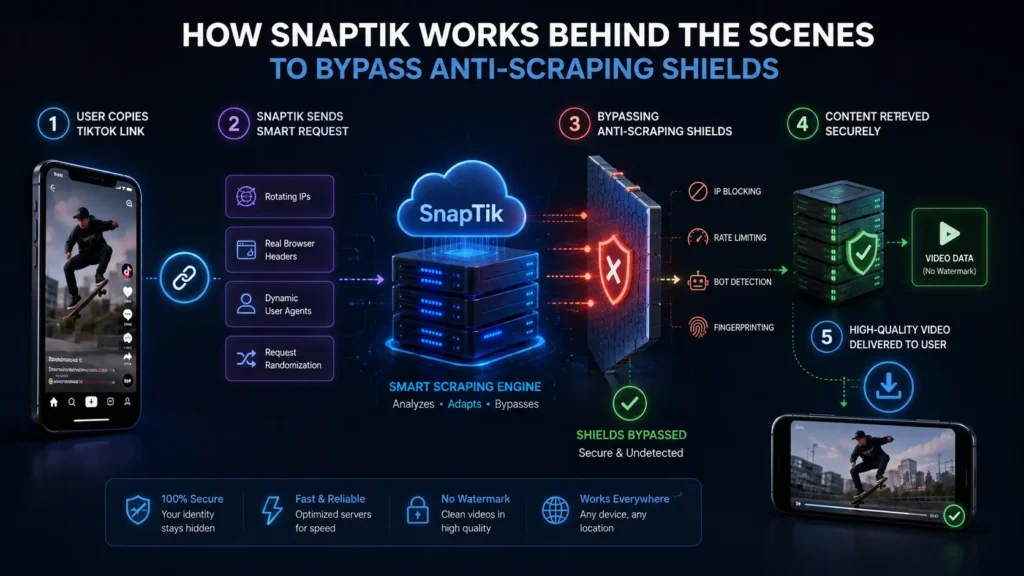
Social media platforms employ strict anti-bot mechanisms to protect their infrastructure from unauthorized scrapers. These security layers inspect incoming HTTP requests for suspicious headers, rapid IP requests, and unnatural browser signatures. Therefore, proxy rotation strategies are core to how SnapTik works behind the scenes to pass as a human user.
User-Agent Spoofing and Header Emulation
Standard programmatic HTTP clients leave default headers that anti-bot tools flag immediately. To avoid detection, SnapTik dynamically injects realistic mobile User-Agent strings into every backend request. Furthermore, it appends headers like Accept-Language, Sec-Fetch-Mode, and Referer to match standard mobile Safari or Chrome browsers.
Smart Residential Proxy Rotation
If a single IP address sends thousands of extraction requests per minute, target servers block it quickly. For this reason, SnapTik routes outbound queries through dynamic residential proxy networks. By rotating IP addresses across global locations, the system distributes traffic naturally and avoids rate-limiting blocks.
Step 3: Inspecting DOM Trees and Extracting Hidden Data
Many users believe SnapTik processes videos using resource-heavy computer vision software to blur or remove watermarks. In reality, the watermark overlay is added on the client-side app layer. The raw, clean video file already exists in uncompressed form on the content delivery server.
Extracting Embedded JSON Payloads
When a web browser requests a video page, the platform injects a JSON state object inside a script tag. In modern web development, this technique is known as client-side rehydration. SnapTik parses this raw HTML document, searches for designated script IDs, and converts the embedded JSON string into readable structured data.
Uncovering Hidden Endpoint References
Inside the parsed JSON data, the backend searches for key-value pairs associated with media paths. For example, variables such as playAddr, downloadAddr, or bitrateInfo contain direct HTTP parameters pointing directly to raw MP4 files.
The table below summarizes how different parameters function within the JSON structure:
| JSON Key Variable | Media Type | Watermark Status | Purpose in Architecture |
playAddr | H264 / MP4 | No Watermark | Direct link to original unwatermarked video stream |
downloadAddr | H264 / MP4 | Watermarked | Official app export link with animated logo overlay |
music / playUrl | MP3 / AAC | N/A | High-quality audio track isolated from video background |
dynamicCover | WebP / GIF | N/A | Animated thumbnail generated for preview components |
Step 4: How SnapTik Works Behind the Scenes to Reverse Engineer Private APIs
Parsing raw HTML works well, but platforms continuously update their website layouts to break web scrapers. To maintain fast service, API signature generation is vital to how SnapTik works behind the scenes when querying private REST endpoints directly for clean JSON.
Signature Generation Mechanisms
Mobile API requests require cryptographic signing tokens to prove authenticity. For example, headers like X-Gorgon, X-Khronos, and X-Bogus validate client calls. Security engineers reverse engineer these signature algorithms from mobile binaries. Consequently, SnapTik can generate valid security headers programmatically on demand.
Fetching Metadata via Private Endpoints
Once the signature engine builds valid headers, SnapTik queries the backend endpoint directly. In response, the server returns a lightweight payload containing video resolution variants, frame rates, and direct CDN storage paths. As a result, this API approach reduces data bandwidth and speeds up response times.
Step 5: Media Processing Secrets and Watermark Removal Mechanics
Does SnapTik re-encode or crop videos to remove logos? The short answer is no. Re-encoding media requires heavy GPU processing power and reduces overall video quality. Direct CDN stream extraction is central to how SnapTik works behind the scenes without altering the video master file.
Direct CDN Linking vs. Video Re-encoding
When creators upload videos, social platforms compress and store raw master files on media distribution servers. The platform app adds watermark animations dynamically during client playback. Because SnapTik locates the raw master file, it bypasses the watermark layer entirely. Consequently, users receive the exact high-definition video that was originally uploaded.
Image Slide Show Processing
In addition to videos, platforms host photo carousel posts. For photo posts, SnapTik’s backend parses array objects containing image assets and audio streams. Then, the server either presents individual high-resolution image links or compiles them into an MP4 slideshow on the fly using headless media tools like FFmpeg.
Step 6: How SnapTik Works Behind the Scenes to Stream Media via Edge Proxies
Once SnapTik isolates the unwatermarked media link, it must send the file to the user. However, media delivery networks enforce Hotlink Protection. Secure streaming proxy layers demonstrate how SnapTik works behind the scenes to deliver raw files despite HTTP header checks.
Bypassing Hotlinking Restrictions
To bypass hotlinking blocks, SnapTik routes video downloads through its own streaming proxy servers. The user clicks a download button that connects to SnapTik’s proxy endpoint. Next, the proxy server requests the CDN file, attaches the required headers, and streams data chunks directly to the user’s browser.
Serverless Infrastructure and Cost Optimization
Processing millions of proxy requests requires significant infrastructure resources. Therefore, SnapTik leverages serverless edge compute networks like Cloudflare Workers or AWS Lambda. These serverless functions scale automatically during high traffic and spin down when idle. Consequently, the platform maintains ultra-fast speeds while keeping server overhead low.
Technical Comparison: SnapTik vs. Standard Downloaders
To understand why SnapTik remains popular, let us compare its technical stack against traditional video downloaders.
| Feature / Metric | SnapTik Downloader | Traditional Web Scraper | Screen Recording Apps |
| Extraction Method | Direct CDN / API Retrieval | HTML DOM Scraping | Frame-by-Frame Capture |
| Watermark Removal | Native Bypass (No Re-encoding) | Crop or Blur Overlay | Logo Preserved in Frame |
| Processing Speed | Extremely Fast (1–3 Seconds) | Moderate (5–10 Seconds) | Real-time Duration |
| Video Quality | Original Source Resolution | Frequently Lossy | Degraded / Compressed |
| Server Overhead | Low (Serverless Proxy) | High (Headless Browsers) | Device Dependent |
Frequently Asked Questions (FAQs)
Conclusion
SnapTik’s speed and reliability are not the result of magic. Instead, understanding how SnapTik works behind the scenes reveals a system built on efficient software architecture, smart parsing, and clever API engineering. By locating raw CDN files directly, SnapTik bypasses watermarks without time-consuming video processing. Ultimately, these mechanics highlight the power of modern web scraping, distributed serverless proxies, and real-time data extraction.